You can usually tell within the first two lines. A blog post that starts with “In today’s fast-paced digital world” or ends every section with “In conclusion” has a certain smell to it. Readers pick up on it fast, and so does Google.
The tricky part is that AI writing tools are genuinely useful. They save hours on research, structure, and first drafts. The problem is not the tool itself, it is how most people use it. They copy the output, paste it straight into their site, and publish it without touching a single sentence.
This guide walks through exactly how to use these tools to speed up your writing process while still producing something that reads like it came from a real person who knows the topic. If you run a blog, manage content for clients, or write for your own business, this is the difference between content that ranks and gets read, and content that gets skimmed for ten seconds and closed.
Why AI-Sounding Content Hurts Your Blog
Before getting into the fixes, it helps to understand why this actually matters for your traffic and not just your pride as a writer.
- Readers bounce faster. If the first paragraph feels generic, people leave before reaching your actual point, and that bounce signal tells search engines your page did not satisfy the search.
- Trust drops immediately. Content that sounds like everyone else’s content does not build authority. Readers remember writers who sound like they have actually done the thing they are writing about.
- Search engines are getting better at detecting patterns. Repetitive sentence structures, overused transition words, and vague claims without specifics are easy patterns to spot at scale.
- It kills conversions. A reader who does not trust your writing will not trust your product recommendation, your service, or your call to action either.
None of this means you should stop using AI tools for writing. It means you need a process that turns a raw draft into something worth publishing.
Step 1: Never Start With a Blank Prompt
The biggest mistake is typing a title into a tool and publishing whatever comes back. Generic input produces generic output every time.
Instead, feed in details before you ask for a draft:
- Who exactly is this for? A beginner? Someone comparing options before buying?
- What specific experience or example can you include that nobody else would think of?
- What tone fits your brand? Casual and direct, or detailed and formal?
- What should the reader be able to do after reading this that they could not do before?
The more specific your input, the less generic your output. A prompt like “write a blog about productivity tips” will always sound the same as a thousand other blogs. A prompt built around your own angle, your own examples, and your own reader will not.
Step 2: Rewrite the Opening Paragraph Yourself
The introduction is where AI-sounding content is most obvious, and it is also the part search engines and readers judge first. Generic openings tend to restate the title in a slightly longer sentence and add a broad statement about how important the topic is.
A stronger opening does one of these instead:
- Opens with a specific scenario the reader will recognize immediately
- States an opinion or a slightly surprising fact right away
- Skips the setup and gets straight to the useful part
Compare these two openings for a post about morning routines:
Generic: “In today’s busy world, having a good morning routine is more important than ever for productivity and success.”
Better: “Most morning routine advice assumes you have an hour of free time before work. If you don’t, here is what actually works.”
The second one sounds like someone who has actually dealt with the problem. That is the tone you are aiming for throughout the whole piece, not just the intro.
Step 3: Cut the Filler Transition Words
Certain words show up constantly in AI-generated drafts: ultimately, additionally, furthermore, moreover, and in conclusion. None of these are wrong on their own, but when they appear in every other paragraph, the pattern becomes obvious.
Read through your draft and replace repeated transitions with something more natural:
- Instead of “Additionally, you should consider…” try “Another thing worth checking is…”
- Instead of “Furthermore, this approach…” try “This also means…”
- Instead of “In conclusion, it is clear that…” try just stating your final point directly, without announcing that you are concluding.
Real writers vary their sentence starters naturally because they are thinking through the idea as they write, not filling a template. You can train yourself to do this by reading your draft out loud. If a sentence sounds like something you would never actually say to a colleague, rewrite it.
Step 4: Add Specific Details a Generic Draft Cannot Include
This is the single most effective way to make content sound human, and it is also what search engines reward under their guidelines around genuinely helpful, experience-based content.
Generic drafts speak in vague terms because they have no real experience to pull from. You do. So add it in:
- A specific number instead of a vague range (“cut load time by 1.2 seconds” instead of “improved load time significantly”)
- A real mistake you made and what you learned from it
- A tool, method, or resource you actually use, with a reason why
- An exception to the general advice, based on something you have seen happen
One specific detail can do more for credibility than three paragraphs of general explanation. It also naturally supports the experience and expertise that search engines look for when deciding whether content deserves to rank.
Step 5: Vary Your Sentence Length on Purpose
AI-generated paragraphs often settle into a steady rhythm of similar-length sentences. Human writing naturally moves between short and long sentences without thinking about it.
After drafting a section, scan it for rhythm. If every sentence is roughly the same length, break some up and combine others. A short sentence after a longer explanation adds emphasis. It also makes the whole piece easier to read on a phone screen, where long unbroken paragraphs feel heavier than they actually are.
Step 6: Structure for Readers, Not Just for Keywords
Good structure helps both search rankings and actual readers, but chasing keyword placement over readability backfires both ways.
- Use H2 headings for main sections and H3 for subpoints within them, based on what a reader would naturally want to jump to, not based on stuffing in keyword variations.
- Keep paragraphs short. Two to four sentences is usually enough before you need a break.
- Use bullet points for lists of options, steps, or comparisons, but do not convert every sentence into a bullet just to fill space.
- Place your main keyword naturally in the introduction, at least one heading, and the conclusion, without repeating it so often that it reads awkwardly.
Step 7: Fact-Check Before You Publish
AI tools can produce confident-sounding statements that are outdated or simply wrong. This matters more than style, because inaccurate claims damage trust permanently, while an awkward sentence just gets skimmed past.
Before publishing, check:
- Any statistic, date, or pricing figure against a current source
- Any product feature or tool comparison, since these change frequently
- Any claim about “the best” or “the only” way to do something, since these are usually oversimplified
If you are not confident a fact is accurate, either verify it or remove it. A shorter, accurate post beats a longer post with a wrong number in it.
Step 8: Read It Back as the Reader, Not the Writer
Once your draft is done, read it from the top as if you just landed on the page from a search result with a specific question in mind. Ask yourself:
- Does this answer my question in the first few paragraphs, or do I have to scroll to find it?
- Would I trust this person’s advice based on how they explain things?
- Is there anything here that feels like it was written just to hit a word count?
If any section fails that test, cut it or rewrite it. Length does not help rankings if the content padding it out adds no value.
A Simple Workflow That Actually Works
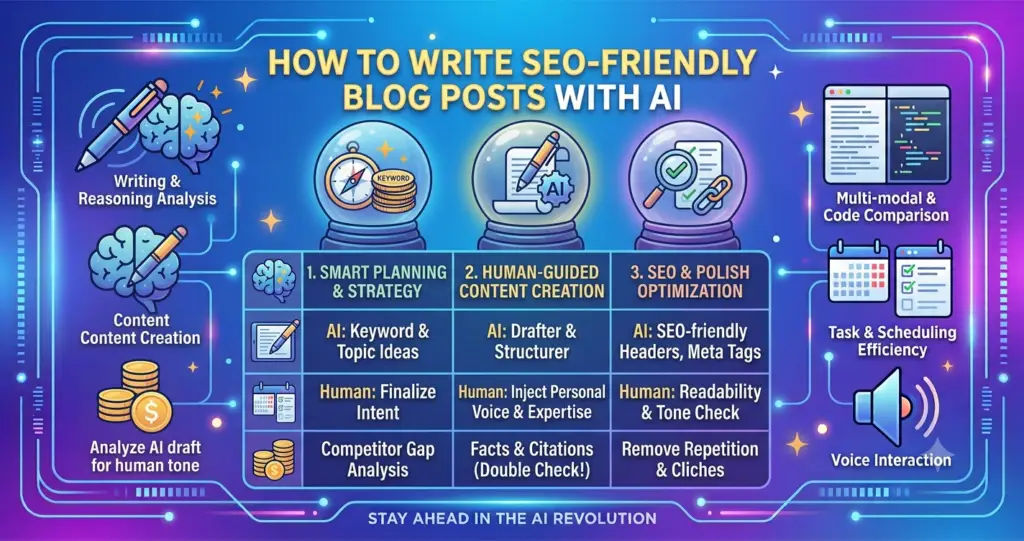
Putting all of this together, here is a repeatable process:
- Write a detailed, specific prompt with your angle, audience, and tone
- Generate a first draft to use as a structural starting point
- Rewrite the introduction completely in your own words
- Scan for repeated transition words and vary them
- Add at least three specific details, numbers, or examples the draft could not have generated on its own
- Vary sentence length throughout
- Fact-check every claim, statistic, and date
- Read the full piece back as a reader searching for an answer, and cut anything that does not earn its place
This process takes maybe twenty extra minutes compared to publishing a raw draft, but the difference in how the content performs and how readers respond is significant.
Conclusion
Using AI tools to speed up your writing is not the problem. Publishing the first draft without adding your own knowledge, your own examples, and your own voice is. The blogs that actually build an audience and rank well over time are the ones where a real person’s experience clearly sits behind every claim. Treat these tools as a starting point for structure and speed, then do the work that only you can do: the specific details, the honest opinions, and the small human touches that make a reader trust what they are reading.